
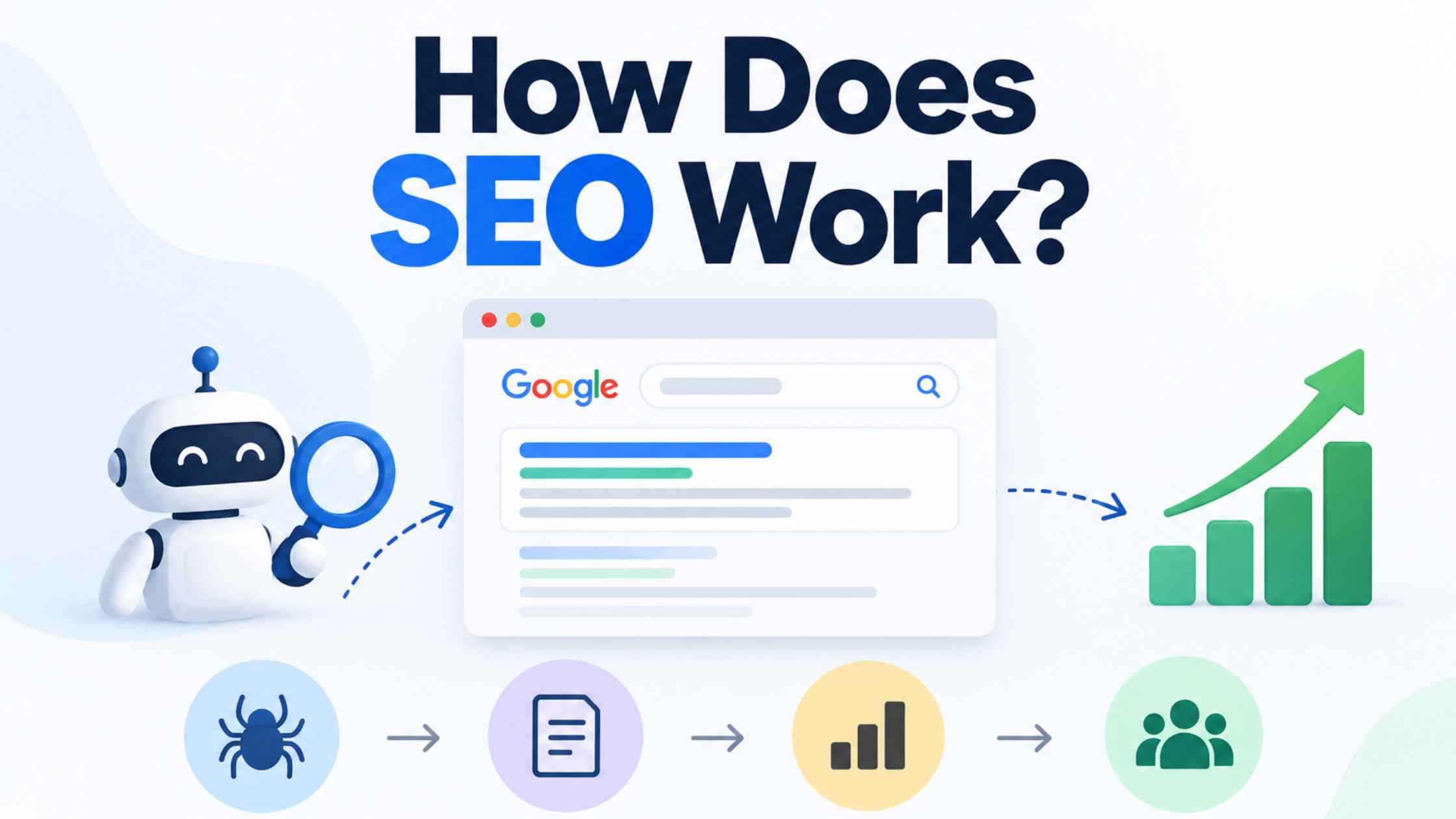
SEO works by helping search engines understand your website and show the right pages to people searching for relevant information.
When you publish a page, Google first discovers it, crawls the content, and decides whether to add it to its index.
When someone searches, Google looks at many signals to find pages that are relevant and useful for that search.
In simple terms, SEO works through crawling, indexing, and ranking.
SEO is not just about using keywords. It also involves creating helpful content, matching search intent, improving your website, and building trust and authority.
In this guide, you’ll learn how SEO works step by step and how you can improve your website’s visibility on Google.
How Does SEO Work?
The easiest way to understand SEO is to look at what happens after you publish a webpage.
Suppose you publish an article called:
“How Does SEO Work?”
For people to find this article through Google, Google first needs to discover the page, understand what it is about, and decide whether it is useful for a particular search.
The basic process looks like this:
Publish a page → Google discovers it → Google crawls it → Google understands and indexes it → Google ranks it for relevant searches → People find and visit the page
There are three important terms you should understand:
- Crawling
- Indexing
- Ranking
Let’s look at each one.
1. Crawling: Google Finds Your Page
The first step is for Google to discover your webpage.
Google uses automated programs called Googlebot to find and visit webpages.
Google can discover your page through:
- Internal links
- XML sitemaps
- Links from other websites
- Previously discovered URLs
For example, you publish a new article on your website:
example.com/how-does-seo-work
Google may discover this page through your XML sitemap or through a link from another page on your website.
Think of Google like someone exploring a huge library.
Before it can understand your new book, it first needs to find it.
After Google discovers your page, it tries to understand what the page is about.
2. Indexing: Google Understands Your Page
Google can analyze things such as:
- Page content
- Headings
- Images
- Links
- Page title
- Other information about the page
If Google considers the page suitable for its search index, it may store information about that page.
You can think of Google’s index as a huge digital library.
Google has found your page and stored information about it so that it can potentially show the page when someone performs a relevant search.
Indexing means Google processes and stores information about your webpage.
In simple words:
It’s important to remember that crawling and indexing are not the same thing. Google can crawl a page without necessarily indexing it.
3. Ranking: Google Decides Which Pages to Show
Now comes the part most website owners are interested in: ranking.
When someone searches on Google, Google has to choose which pages to show and in what order.
For example, imagine someone searches:
“What is SEO?”
There may be thousands of webpages that discuss SEO.
Google needs to determine which pages are relevant and useful for that particular search.
It looks at many different signals and considers things such as:
- Relevance
- Content quality
- Search intent
- Website and page context
- Links
- Page experience
- User’s location and other context
There is no single factor that guarantees a page will rank number one.
In simple words:
Ranking means Google decides which relevant pages to show for a search and where to place them in the results.
What Is Search Intent in SEO?
Search intent is simply the reason behind a person’s search.
Before creating content, you should understand what the person actually wants.
For example:
| Search | Possible Intent |
| What is SEO? | Learn about SEO |
| How does SEO work? | Understand the SEO process |
| Best SEO tools | Compare SEO tools |
| SEO agency in Nashik | Find an SEO service |
| Buy SEO course | Purchase a course |
If someone searches “What is SEO?”, they probably want an explanation.
Showing them a page that only sells SEO services may not satisfy their search.
This is why understanding search intent is an important part of SEO.
Don’t create content only because a keyword has search volume. Create content that answers what the searcher actually wants to know.
How Do Keywords Work in SEO?
Keywords are the words or phrases people type into search engines.
For example:
- SEO agency
- SEO services
- How does SEO work?
- Local SEO
- SEO for beginners
- Best SEO tools
Keyword research helps you understand what your audience is searching for.
However, SEO is not about repeating the same keyword again and again.
For example, this is poor writing:
SEO is important for SEO because SEO helps improve SEO rankings through SEO.
It sounds unnatural and does not help the reader.
Instead, use keywords naturally while explaining the topic clearly.
Google can understand the overall meaning and context of content, so focus on covering the topic properly rather than forcing keywords into every sentence.
How Does Content Help SEO?
Content is an important part of SEO.
If you want people to find your website through Google, you need content that answers their questions and helps them solve problems.
Good SEO content should:
- Be useful
- Be easy to understand
- Answer the user’s question
- Match search intent
- Provide accurate information
- Be well organized
- Add genuine value
For example, if you are writing about “How Does SEO Work?”, don’t just define SEO.
Explain:
- What SEO means
- How Google finds websites
- How crawling works
- How indexing works
- How ranking works
- What search intent means
- How keywords are used
- How businesses can improve SEO
This gives the reader a complete understanding of the topic.
What Factors Affect SEO Rankings?
There is no single checklist that guarantees a number-one ranking on Google.
Google uses many signals to determine which results are relevant and useful for a particular search.
Some important SEO areas include:
| SEO Area | Why It Matters |
| Content | Helps answer the user’s question |
| Search intent | Makes content relevant to the search |
| Technical SEO | Helps search engines access your website |
| Internal links | Connect related pages |
| Backlinks | Can contribute to website authority |
| Page experience | Helps users use the website |
| Mobile experience | Important for mobile users |
| Website structure | Helps organise your content |
The importance of these signals can vary depending on the search query.
How Long Does SEO Take to Work?
SEO does not usually produce instant results.
The time it takes can depend on:
- Website age
- Competition
- Industry
- Website authority
- Content quality
- Technical problems
- Keyword competition
- Backlinks
- Consistency of SEO work
Some SEO improvements may show results relatively quickly, while competitive keywords can take much longer.
This is why SEO should be treated as a long-term strategy rather than a one-time task.
Instead of asking only, “How quickly can I rank?”, focus on continuously improving your website and providing better information to your audience.
Simple SEO Checklist
Before publishing or optimising a page, use this SEO checklist.
Content
- Does the content answer the user’s question?
- Does it match search intent?
- Is the information accurate?
- Is it easy to understand?
- Does it provide genuine value?
On-Page SEO
- Is the page title clear?
- Is there a clear H1?
- Are headings organized properly?
- Are keywords used naturally?
- Are relevant internal links included?
- Are images optimized?
Technical SEO
- Can Google access the page?
- Can Google index the page?
- Is the website mobile-friendly?
- Does the page load properly?
- Is the URL correct?
Business
- Does the page support a business goal?
- Is there a clear next step for the visitor?
- Can the page help generate leads or conversions?
Conclusion
SEO may seem complicated when you first start learning it, but the basic idea is simple.
SEO helps Google understand your website and helps people find the information they are looking for.
To improve your SEO, focus on creating useful content, understanding search intent, keeping your website technically healthy, using internal links, building authority, and providing a good experience for visitors.
SEO is not a one-time task. It takes time and consistent effort.
The goal should not be to simply rank for keywords. The real goal is to reach the right audience, provide value, and turn search visibility into meaningful results for your website or business.
